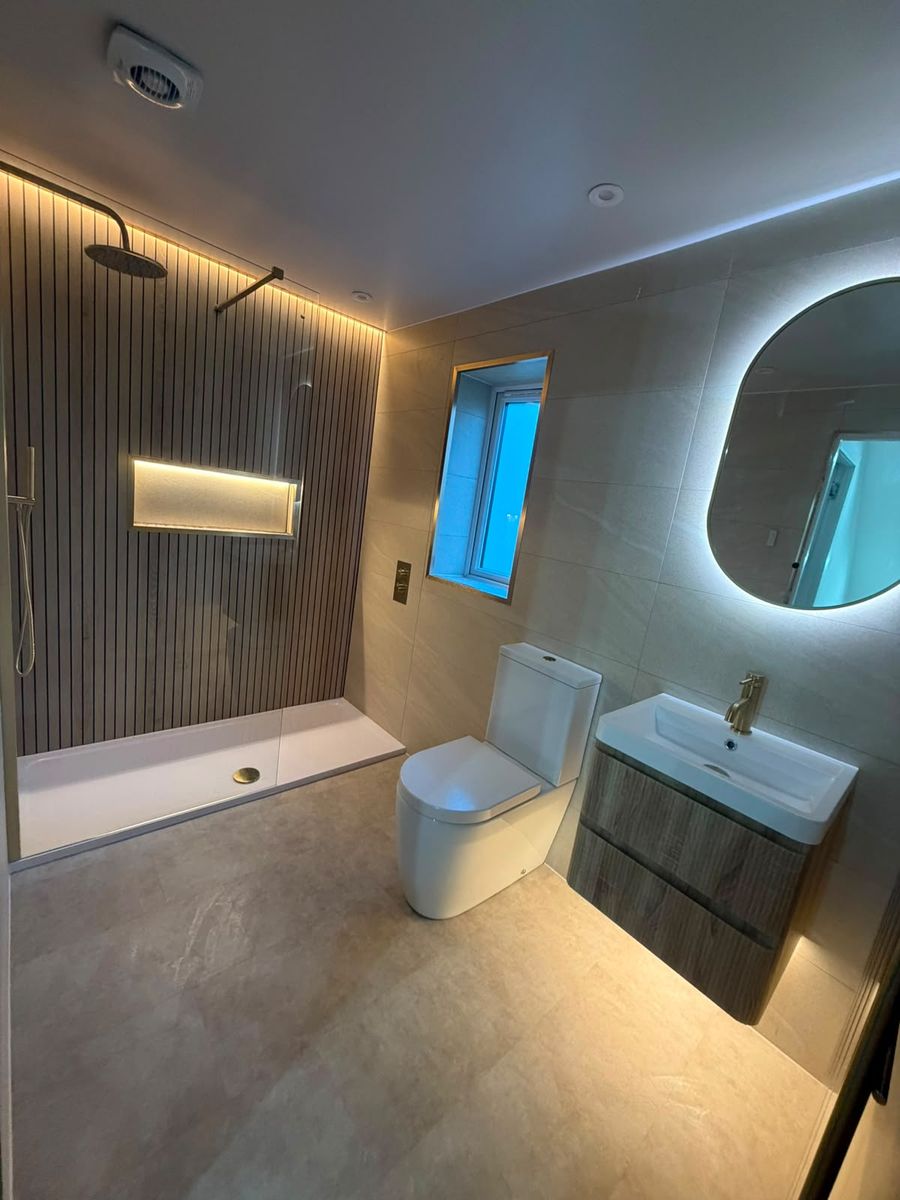
Can LED lighting be added to a bathroom I already have?
Some of it, yes. A backlit mirror needs a feed run to it, which is often possible through a loft or from an existing light point. A cove can sometimes be built onto the existing ceiling as a dropped detail. What is genuinely hard to retrofit is a lit niche, because that means opening a wall. We look at the room and tell you which parts are worth doing without a full refit.
Is LED strip lighting safe in a bathroom?
It is, when the fitting is rated for the zone it sits in and the driver is kept out of the wet zones and left accessible. The risks come from unrated strip bought online and drivers tiled over. Everything we install is specified for its zone and left serviceable.
What colour temperature works best in a bathroom?
Warm white around 2700K to 3000K for the feature and cove lighting, and something a little cooler at the mirror where you need to see your face honestly. Mixing the two is why a well lit bathroom feels calm at night and still works at seven in the morning.
Will feature lighting add a lot to the cost?
Less than most people expect when it goes in with the rest of the work, because the cable runs happen while the walls are already open. Adding the same scheme afterwards costs considerably more, which is exactly why it is designed in from the first visit rather than offered as an upsell at the end.
How long do the LEDs last, and what happens when one fails?
Quality strip and drivers run for many years, and it is almost always the driver that goes rather than the LEDs. That is why the driver is left accessible, in a cupboard or behind a removable panel, so replacing one is a ten minute job and not a retiling job.
Do the lights need their own switch?
They get their own circuit and control, yes. Feature lighting on the same switch as the main light defeats the point of it. Most rooms end up with a main light, a feature or cove circuit and the mirror, sometimes with a dimmer on the cove.